
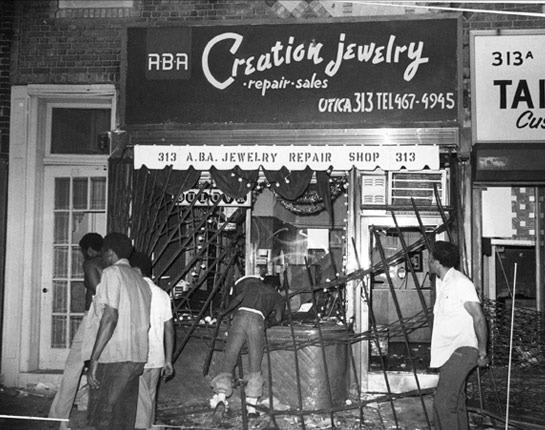
 Coming to PBS’s American Experience tomorrow, Tuesday, July 14: BLACKOUT
Callie T Wiser’s look back at the tumultuous New York City blackout of 1977 makes its debut on the long-running public television series.
Thirty-eight years ago to the date, on July 13, 1977, a severe lightning strike in Westchester county set off a chain reaction that resulted in a total blackout for virtually all of New York City. In comparison to a similar power failure just twelve years prior, which saw masses of ordinary New Yorkers helping to maintain order and safety, this one became characterized as something more sinister, noted for widespread looting and arson that left long-lasting wounds for many neighborhoods and their residents. Wiser gathers an impressive assemblage of period footage, and draws from the recollections of a range of people who lived through that dark night, from Con Edison employees who were tasked with restoring power and shop owners who saw their businesses ransacked, to police officers and firefighters who faced the thankless job of trying to maintain order in the chaos and neighborhood residents who tried to make sense of it all. Without forgiving the perpetrators, some of the interviewees point out that, rather being primarily a racial issue, as was suggested at the time, the criminality that emerged in some areas were more a reflection of class, a response to the devastating unemployment and reduction in social services that characterized an essentially bankrupt New York City. Through its cogent contextualization of these and other factors, the film underscores this, contrasting recollections of staff at the World Trade Center’s Windows on the World restaurant, which appeased diners during the blackout by offering free champagne, with the spontaneous looting of under-served neighborhoods, carried out not only by career criminals but by first-time offenders, many taking illegal advantage of the absence of social order to steal diapers and food for their families. That there were victims of this behavior is not ignored, of course, as represented by a shop owner who lost hundreds of thousands that evening, and who could not accept that the actions taken, whatever the circumstances, were justified.

 what (not) to doc