
 My latest curation of Hulu Documentaries page for indieWIRE focuses on the environmental docs.
For more information about the selections, take a look at my iW article.
My latest curation of Hulu Documentaries page for indieWIRE focuses on the environmental docs.
For more information about the selections, take a look at my iW article.
Filed under Documentary, Film, Indiewire @ Hulu Docs, Recommendations
 The latest post in my contribution to IFP’s “Ask the Expert” blog is up, focusing on the pros and (mostly) cons of using film festival deadlines as your film’s production deadline. Take a look here.
Update: The original post seems to have gone missing from IFP’s site, so I’ve posted the article below.
Dear Filmmakers:
In my first blog post for IFP, I briefly addressed the issue of using a specific festival’s deadline as your own film’s production deadline. In this post, I’m going to expand a bit on this topic.
You have to plan out your production schedule anyway, so what’s the problem with using Sundance or Toronto’s final submission deadline as your own deadline for having a showable rough cut or even fine cut? At the basic level, there’s not necessarily anything wrong with this strategy. After all, you do have to finish your film at some time if you want to give it a chance of getting out into the world through festivals or potential distribution. Having a specific date or date range is a great motivator and helps you tackle the daunting process of editing and other post work in a tangible way. I’d frankly be concerned if you didn’t have some sense of when you were planning to be finished.
At the same time, any deadline you set for your film is ultimately an arbitrary date, and one subject to any number of delays and rescheduling both under your control and not. Barring being granted a slight extension by the festival, the submission deadline is not so flexible. As a result, some filmmakers lose sight of their own project and focus on that submission deadline as the end-all, be-all, and force themselves to come up with something, anything in time to get it in to the festival by that date. Putting the metaphorical cart before the horse, these filmmakers are convinced that they have to get into that specific festival, but they haven’t even finished their film properly to actually position it for programming.
If you follow this route, you may end up cutting corners, creating a cut of your film that looks or sounds sloppy, doesn’t make narrative or logical sense, or is missing key sequences, and yet you decide the programmers of a festival in which you desperately want to premiere should see it. If this doesn’t sound like a bad idea already, it should. You’re not doing yourself, your film, or your collaborators any favors by rushing a subpar project for the purposes of a submission deadline. While programmers, especially those at the top tier fests, are experienced at watching rough cuts and are able to see past the lack of color correction, sound mixing, or even minor missing elements to recognize the potential of the final cut, they can also tell when something they’re watching isn’t nearly ready and could have used a few more weeks, if not months, in the editing suite. Submitting with a cut that’s not there yet can lead some programmers to form a poor opinion on not only your film, but on your sense of judgement regarding your own work. If your film is rejected, and your re-apply the following year, your project may still have a chance at being selected, especially if it’s been improved and hasn’t screened elsewhere in the intervening months, but you also risk the same programmers seeing the re-submission and judging it at least partially on the first impressions they received from the first bad cut they saw.
Let’s say however, that while you rushed to get your film submitted in time, it’s such a promising project that it ends up getting selected. This can be a double-edged sword – it’s fantastic that you’ve made it into your desired festival, but now you have another one of those inflexible deadlines – the festival’s opening date – and your film is not finished. You have perhaps 6-8 weeks between selection notification and the start of the festival to wrap up all post work so that you have a final, completed film to screen at your premiere. Again, delays are inevitable, people and machinery are fallible. Anything that can go wrong likely will go wrong, at least a little bit. Do you have enough time, allotting some room for these kinds of delays, to get your project to the place you envision it needs to be before it meets the public? If you rushed to get your submission in on time, you are now having to rush even faster to get your finished film to your premiere on time. That’s a lot of pressure, and this can exacerbate even the smaller problems that may have been evident in your rough cut, creating a serious flawed final cut. You might end up with a film radically different than what you wanted, and one that ends up being unsuccessful as a result, even if it premieres at Berlin or Cannes.
I don’t mean to be all doom and gloom, but I do want to give you pause for thought. As with every aspect of your work, you should plan ahead and be realistic about what you can and can’t accomplish in a given timeframe. Create a practical timeline for all elements of post-production, including a back-up plan should you run into unforeseen delays that allows for some flexible cushioning by a week or two, just in case. By all means, use your dream festival premiere as the end point of your post, and work backwards from there to see if its feasible timewise to make it. If you’ve worked out a comfortable 26-week post schedule, and the festival is 16 weeks away, do the math. Bad idea. Don’t become too fixated on the idea that you have to premiere at a particular festival – there are other options that can serve your film just as well, if not better, depending on what kind of a film you have and what kind of exposure the festival is known for providing. On the other hand, if you are absolutely convinced that your number one choice for a festival premiere is the best for your film, you can make the difficult, but smarter, choice of waiting and submitting the next year rather than compromising on post and submitting this year with an inferior and premature version of your project. Take that extra year to hone your film into being the best that it can be, so that when you do finally get it into programmers’ hands, they will see the film you wanted them to see all along. Determine the rest of your festival strategy, beyond the premiere. If appropriate, look into sales agents and publicists who can hopefully help sell your film. Spend time on your social media marketing and other promotion to create and expand your fanbase for the project, so that there’s anticipation for its eventual premiere and, hopefully, for its distribution down the line. And, most importantly, take some time to sleep and to breathe – luxuries the other, rushed, scenario doesn’t necessarily provide the opportunity for…
ABOUT THE WRITER: Basil Tsiokos is a Programming Associate, Documentary Features for Sundance, consults with documentary filmmakers and festivals, and recently co-produced Cameron Yates’ feature documentary “The Canal Street Madam.” Follow him on Twitter @1basil1 and read his “Dear Documentary Filmmakers” advice at WhatNotToDoc.com.
Filed under Documentary, Film, Film Festivals, Recommendations
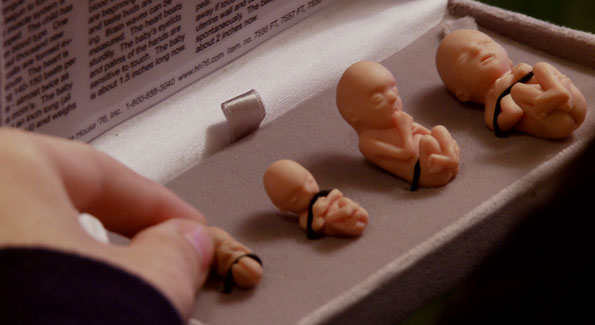 Coming to NYC’s Stranger Than Fiction next Tuesday, November 16: 12TH & DELAWARE
Co-directors Heidi Ewing and Rachel Grady debuted their new film at Sundance this year. It’s gone on to screen at others festivals and on HBO and is coming to STF as part of their fall season.
No strangers to controversial subjects, as their previous film JESUS CAMP demonstrated, the duo take a critical look at abortion, at the titular microcosm, a street corner where a clinic is situated right across the street from a pro-life organization. Expertly allowing the passionate pro- and anti- forces to tell their own stories, the doc emerges as close as possible to a film that could potentially be embraced by both sides in the intractable abortion debate, even if the pro-choice side is clearly favored. Eschewing narration, Ewing and Grady instead focus their cameras on the experiences of the women who are caught in the middle, often duped into believing the pro-life building is the abortion clinic due to their manipulative practices, and promised support to carry through with their unwanted pregnancies – support which doesn’t materialize in the way they expect. 12TH & DELAWARE is intelligent, subtle, and provocative.
Filed under Documentary, Film, Recommendations, Sundance
 Just a quick reminder that I’m scheduled to lead a workshop for Raindance New York this coming Monday, November 15: Does Your Trailer Work? More info, including a link on how to sign up, in this previous post.
Filed under Documentary, Film, Recommendations
 Coming to theatres next Friday, November 12: COOL IT
Ondi Timoner, the director of Sundance award winners DIG! and WE LIVE IN PUBLIC debuted her newest doc at Toronto. Roadside Attractions brings the climate change film, focused on controversial author Bjorn Lomborg, to theatres next week. A couple of days before that, NYC’s 92Y Tribeca will be hosting a special screening next Wednesday, November 10, with a discussion and Q&A moderated by me.
I wrote about the film in the first part of my Toronto round-up here.
Filed under Documentary, Film, Recommendations, Releases
 Coming to NYC’s Stranger Than Fiction next Tuesday, November 9: WAR DON DON
I wrote about Rebecca Richman Cohen’s SXSW award-winning film earlier here.
If you’re in the NYC area, go to STF for a chance to see the film on the big screen.
Filed under Documentary, Film, Recommendations
On Monday, November 15, together with Trevite Willis, I’ll be leading a workshop for Raindance New York assessing the promotional and fundraising trailers of documentary and narrative filmmakers.
Trevite and I will be reviewing trailers submitted by pre-enrolled class participants in advance and offering our feedback during the class, engaging in a discussion about what aspects did (and didn’t) work and how the trailers can better be developed to represent your goals. Constructive criticism will be sought from other attendees to help strengthen your trailer for promotional or fundraising purposes. We’ll also evaluate trailers received the night of the class, but to guarantee a more involved review, you are encouraged to pre-register by Sunday, November 7th.
Sign up now for Does Your Trailer Work?
Filed under Documentary, Film, Recommendations
 About a month ago, I offered some brief thoughts on the first titles announced in the inaugural DOC NYC line-up. The festival launches this Wednesday, and I’ve been remiss in commenting upon the remainder of the selections announced last month.
There’s been one change in the Viewfinders competition – Toronto International Film Festival title ANPO by Linda Hoaglund has replaced fellow TIFF doc THE SOUND OF MUMBAI, which won’t be screening in the festival after all. My thoughts on ANPO are here.
Filed under Documentary, Film, Recommendations
With the very important midterm elections happening tomorrow, indieWIRE and I have rushed the new edition of our curated Hulu Documentaries page to focus on a number of docs looking at various local and national elections, as well as on political divide in the country.
For more information about the selections, take a look at my iW article.
Filed under Documentary, Film, Indiewire @ Hulu Docs, Recommendations
If you’re based in the NYC area or planning on being in town this coming Wednesday, November 3rd at 4pm, I’ll be moderating the first panel at DOC NYC, New York’s newest doc festival, organized by the creators of Stranger Than Fiction and by the IFC Center.
Entitled “State of the Industry,” the panel is in two parts – the first featuring filmmakers and the second industry representatives – each separately reflecting on the past year in non-fiction filmmaking from more of a business perspective, offering audiences a chance to get their insider’s view.
Best of all, the event is free – but you need a ticket. Read more about the panel and secure your seat here.
Filed under Documentary, Film, Recommendations


